


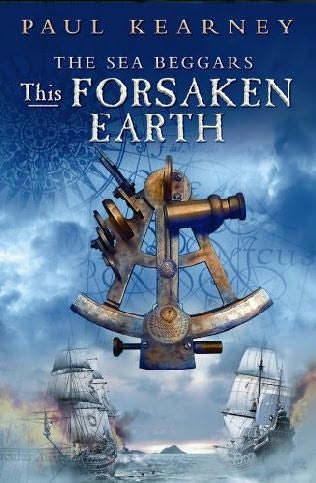
by PAUL KEARNEY
Format: Paperback, 368/336 pages
Publisher: Bantam Press/Spectra (July/November 2006)
-Format: Paperback, 368/336 pages
Publisher: Bantam Press/Spectra (July/November 2006)
-
KEARNEY needs no introduction on RoSF, as we have already given him a lot of attention; I reviewed a couple of his books: (1) “The Mark of Ran”, the first book of The Sea Beggars trilogy (2) and “The Ten Thousand”, a heroic tale of a highly organised mercenary army and its epic journey through a hostile empire. “This Forsaken Earth” picks up where “The Mark of Ran” left off - with Rol Corthishane running from himself and his past to live as a ruthless but loyal pirate captain. While this book cleverly eschews some of the pitfalls of the middle-book syndrome it is in other ways still deeply trapped by those same dangers: the most obvious one is how the story, which was sublimely set up in “The Mark of Ran”, develops but little.
But if the plot progression disappoints to an extent, the reading experience itself is still as emotionally mesmerising as was with the previous book, if not more so. The novel doesn't resolve any of the questions raised in the first novel, it even raises some new ones, but while both the story and the main protagonist stagnate, author nevertheless manages to put a few hints here and there that he has something great in store for the reader in the final book of the trilogy, which is yet to be released (hopefully by the end of this year).
Cortishane and his motley crew of followers are flawed and morally ambiguous, but feel real and are likeable. Sadly, Cortishane's most trusted sidekicks lack a bit of character development, but I guess it's hard to fully flesh out a plethora of characters, if you write in such a condensed way as KEARNEY does (this is even more prominent in “The Ten Thousand”, his latest book). I still believe that the author has excellent skills for characterisation, but he intentionally (or unintentionally) chooses not to put it to the forefront of his novels. The bits of story that are character - not plot - driven are brilliant; I especially enjoyed how he handled the interaction between Rol and Rowen, Rol's lost love, when they happen to meet again. If anything, she is a true femme fatale, a woman I could find my self falling for. She is cold, haunting, distant, but scarred and also caring in her own way.
The world wherein the story transpires is lush and mysterious, but again, it remains largely unexploited (and unexplored). One third of the story takes place in the hidden pirate city that we were introduced to in the first book, another part of the story takes place in the war-riven state of Bionar, which was presented all to sketchy for my tastes, and the final part of the story unfolds in a bleak, wintry setting of a certain mountain ridge that Rol and the people that follow his lead have to pass to escape prosecution. To be honest, I enjoyed the first book's setting more, even if it was more static (and small-scale) compared to how this book's story resonates with the surroundings; I'm referring to the large household that was run by a charismatic and vile master, ruled by protocol and riven with hidden chambers (this was freshened up sporadically with Corthishan's forays into the city beyond). But I think I'm straying from the point here.
If I summarize my impressions of “This Forsaken Earth”: I must say, that despite all the niggles I had, the book remained a compulsive read throughout, KEARNEY's storytelling abilities are as sharp as ever and his style leaves the impression of being intentionally brash, simple, primordial and uncompromising at times. I wouldn't say that this book impressed me as much as I wanted it too do, but it certainly has some brilliant moments and is, generally speaking, a work of quality that I can nothing but recommend.
-But if the plot progression disappoints to an extent, the reading experience itself is still as emotionally mesmerising as was with the previous book, if not more so. The novel doesn't resolve any of the questions raised in the first novel, it even raises some new ones, but while both the story and the main protagonist stagnate, author nevertheless manages to put a few hints here and there that he has something great in store for the reader in the final book of the trilogy, which is yet to be released (hopefully by the end of this year).
Cortishane and his motley crew of followers are flawed and morally ambiguous, but feel real and are likeable. Sadly, Cortishane's most trusted sidekicks lack a bit of character development, but I guess it's hard to fully flesh out a plethora of characters, if you write in such a condensed way as KEARNEY does (this is even more prominent in “The Ten Thousand”, his latest book). I still believe that the author has excellent skills for characterisation, but he intentionally (or unintentionally) chooses not to put it to the forefront of his novels. The bits of story that are character - not plot - driven are brilliant; I especially enjoyed how he handled the interaction between Rol and Rowen, Rol's lost love, when they happen to meet again. If anything, she is a true femme fatale, a woman I could find my self falling for. She is cold, haunting, distant, but scarred and also caring in her own way.
The world wherein the story transpires is lush and mysterious, but again, it remains largely unexploited (and unexplored). One third of the story takes place in the hidden pirate city that we were introduced to in the first book, another part of the story takes place in the war-riven state of Bionar, which was presented all to sketchy for my tastes, and the final part of the story unfolds in a bleak, wintry setting of a certain mountain ridge that Rol and the people that follow his lead have to pass to escape prosecution. To be honest, I enjoyed the first book's setting more, even if it was more static (and small-scale) compared to how this book's story resonates with the surroundings; I'm referring to the large household that was run by a charismatic and vile master, ruled by protocol and riven with hidden chambers (this was freshened up sporadically with Corthishan's forays into the city beyond). But I think I'm straying from the point here.
If I summarize my impressions of “This Forsaken Earth”: I must say, that despite all the niggles I had, the book remained a compulsive read throughout, KEARNEY's storytelling abilities are as sharp as ever and his style leaves the impression of being intentionally brash, simple, primordial and uncompromising at times. I wouldn't say that this book impressed me as much as I wanted it too do, but it certainly has some brilliant moments and is, generally speaking, a work of quality that I can nothing but recommend.
 -
--
-
~ Thrinidir ~


