-
Reasons for reading: I had to read it for a paper I was writing.
As soon as I started reading it, I realised that Neuromancer is a very curious book. At first, it's all a bit confusing, with paragraphs describing seemingly random images in the life of a man named Case. Case also seems like a totally random person; we told that he is something, and that he used to be something else, but we have no idea what those 'somethings' actually are until later in the book when we manage to cobble it all together.
In general, Neuromancer is very fragmented. Almost every paragraph deals with a different point in time and space than the previous one, and they all begin in medias res, so the reader is – at least in the beginning – perpetually confused. In other novels, after the initial shock of being thrown into the middle of a story, the reader would slowly get to know what is actually happening (and where); here, he only has time to register the unfamiliar setting before being thrown elsewhere. This has an interesting side effect: for me, reading Neuromancer was a bit like trying to read something written in a language I'm not yet fluent in – I knew it made sense and understood some of it, but mostly, I had no idea what exactly the names and the phrases referred to.
When the prose pauses to describe something in some more detail, however, it's surprisingly evocative:
“He'd missed the first wasp, when it built its paperfine gray house on the blistered paint of the windowframe, but soon the nest was a fist-sized lump of fiber, insects hurtling out to hunt the alley below like miniature copters buzzing the rotting contents of the dumpsters. […] He saw the thing the shell of gray paper had concealed.
Horror. The spiral birth factory, stepped terraces of the hatching cells, blind jaws of the unborn moving ceaselessly, the staged progress from egg to larva, near-wasp, wasp. In his mind's eye, a kind of time-lapse photography took place, revealing the thing as the biological equivalent of a machine gun, hideous in its perfection.”
When I finally managed to put enough pieces together to understand what was going on, I actually began to enjoy the novel. It's the first cyberpunk book I've ever read and I was surprised to find it more intriguing than The Matrix which it inspired (and which I loved). I don't know what exactly it was that drew me to the book so – probably that action is heavily laced with other things, like the mystery of Wintermute and Armitage, the depictions of Villa Straylight and the different parts technology plays in different social groups. I still felt a bit distanced from the story itself, though; maybe it was the jargon that is present throughout the book, but I think the real reason was the general tone of the narration. I don't read much SF precisely because there always seems to be this atmosphere of cold detachment which is also present in Neuromancer – I don't feel especially connected to the characters, even though I might find the book incredibly exciting, as was the case with Neuromancer.
I have to say that Neuromancer is a very good novel. I felt it in the way it was written and in the way the images were practically leaping at me from the pages. My reading experience, however, was not so pleasant – the book didn't really grip me until the last third of it, and by then it was too late – even though I felt that my efforts to keep reading have paid off, the fact remains that getting through the first two thirds were a bit of a chore. I've heard that Neuromancer is a love it or hate it type of book, but I don't really agree with that – I think everyone should at least give it a chance. Neuromancer can be a laboured read or a wondrous journey, and I found a bit of both in it.
3,5/5
Tuesday, May 10, 2011
William Gibson - Neuromancer (Book Review)
Author: Trin published at 4:16 PM 5 comments...
Oznake: cyberpunk, Neuromancer, rating 3plus, review, science fiction, William Gibson
Tuesday, December 28, 2010
Freda Warrington - Midsummer Night (Book Review)
-
Reasons for reading: I got a review copy from the publisher (Tor)
Gil wants to escape from the world, so she books a cottage on an estate belonging to Lady Juliana Flagg, a famous sculptor. Much to Gil's dismay, Lady Flagg's annual art school is taking place on the same estate, meaning Gil won't be as far from other people as she wanted to be. Despite her best efforts to stay away from other people, she stumbles onto a path into Otherworld, the realm of faeries, and forms a new friendship. And while friendship is going swimmingly, the Otherworld only brings trouble – first of them being a young boy who seeks shelter in Gil's cottage.
(This is what Midsummer Nights is actually about. I don't know who wrote the original summary, but it is full of weird mistakes.)
Midsummer Night is a second part of the Aetherial Tales series (first part being Elfland), but even though I didn't read Elfland, I didn't feel like I've missed anything – Midsummer Night can easily be read as a standalone novel. It's been a long time since I've read an urban fantasy book that dealt with the fairy world, and even those I've read last were all YA books, so I was happy to see one written for adults. Luckily, Midsummer Night didn't disappoint.
One of the first things I've noticed was that the troubled protagonist was very well written. Gill, suffering from PSD, is a perfect example of the 'show, not tell' principle - staying in character throughout the first few chapters, being paranoid and filled with irrational guilt, feeling asocial and broken. Her thoughts are full of pessimism, she doesn't know how to act with other people and everything she sees reminds her of the event that caused it all:
“What was it like, to be part of such a clique? Dangerous, maybe. You could find yourself suddenly rejected by the pack, alone and broken.”
Later on, though, Gill gets over her fears and negative feelings; she becomes much more normal and likeable, but also less interesting as a character. The plot of Midsummer Night is pretty generic, but since the book is well-written, I didn't mind it that much. It seemed to me that Warrington was not really trying to give us anything new or unique, but rather trying to write a decent genre book. I was also happy to see that she was aware that the whole 'I accidentally wandered into Otherworld' thing has been around for ages and therefore didn't overdo it – instead of dwelling on Gill's disbelief for a chapter or two, Warrington moves on with the story instead.
Sadly, after the first few chapters, the plot deteriorates a bit – it becomes a very typical urban fantasy plot, with protagonists moving to and fro between Earth and Otherworld and some romance tossed in for good measure. This could become boring very quickly, especially as the Otherworld parts were one of the least interesting in the book, but luckily, the parallel plotline saves the day – dealing with Lady Juliana Flagg's history, it was much more entertaining; I would actually be perfectly happy even if the Otherworld parts (or most of them) had not even been in the book.
While Midsummer Night was not one of my favourite books of 2010, it certainly was one of the best urban fantasy books I've read lately. Warrington obviously knows how to write and if the plot is a bit generic, the very lifelike characters and the family secrets more than make up for it. All in all – enjoyable.

3,5/5
________________________________
They say it's better late than never: merry Christmas, everyone!
Author: Trin published at 7:56 PM 0 comments...
Oznake: 2010, Aetherial Tales, Freda Warrington, Midsummer Night, rating 3plus, review, urban fantasy
Sunday, November 7, 2010
Jaclyn Moriarty - Dreaming of Amelia (Book Review)
-
-
----
-------
When Riley and Amelia transfer to Ashbury High School, they immediately capture everybody's attention and become two of the most popular students. Theirs is, however, not the only mystery of Ashbury High – between all the schoolwork, secret crushes and upcoming HSC (High School Certificate) exams arise the rumours of a ghost that haunts the hallways.
About a month or two ago, I took a short break from epic fantasy – after I read a book and a half of Malazan, I really needed something different, something a bit lighter in style and topic. Around that time, I also noticed Ana's review of Dreaming of Amelia (called The Ghosts of Ashbury High in the US), and decided to give it a try.
At first, I found Dreaming of Amelia very intriguing – the many POV's (Riley, Emily, Lydia, Toby …) are presented to us via an intertextual narrative that uses essays, e-mail correspondence, meeting minutes … to convey the story. It creates the impression that the reader is discovering the story through someone's research on the events that are described and also creates a very plausible high-school atmosphere.
By the time you get to know the characters better, however, the effect of the narrative wears off and the novel gets a bit annoying. I could relate to neither of the characters - Lyda is a spoiled girl with detached parents, Riley thinks that he and Amelia are superior to other students because neither of them comes from a rich family, Emily is a drama queen who likes to throw 'big' words around her essays and is unable to spell words such as 'annihilate', and Toby's essays are mostly telling the story of an Irish convict named Tom Kincaid who lived in New South Wales in early 19th century. This last narrative is actually very interesting, more so than the others, but it does nothing to keep the reader's attention on the main plot, which mostly revolves about how popular Riley and Amelia are and how they excel at everything they do and a ghost that just might be real but probably isn't.
I'm not really sure why I pressed on, but I'm glad that I did. Both the characters and the plot develop after the initial standstill – Em gets a grip on herself and proves that she's more than just a silly girl, Riley and Amelia get friendlier, the secret of the ghost is solved … I found it very nice how all the side plots (Ashbury ghost, Tom the convict) found their epilogue as well as got tied to the main plot. I'm not used to endings where all the loose ends are tied up, but it was really nice to see one of those for a change; it gives the reader a nice feeling of completion at seeing everything wrap up so nicely.
Dreaming of Amelia is not one of those YA books that appeal to readers of all ages; it's clearly aimed at a younger audience. This gave me some problems as I didn't really care about the characters or their (mostly very typical) adolescent problems. I can still say, however, that Dreaming of Amelia was just what I needed - a sweet, undemanding read to pass my time. I just wish I discovered it earlier – I bet my 14 year old self would love it.
- -
3,5/5
Trin
_________________________________
Just deleted >9000 of spam posts. Fun fact: the spambots seem to be drawn to my review of James Enge's Blood of Ambrose :D At least the blog is clean now ^^
Author: Trin published at 10:55 PM 1 comments...
Oznake: 2009, Dreaming of Amelia, Jaclyn Moriarty, rating 3plus, review, The Ghosts of Ashbury High, YA
Monday, March 30, 2009
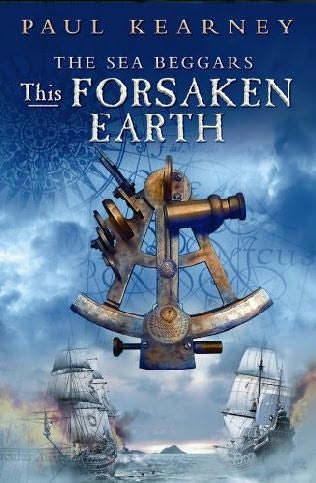
Paul Kearney - This Forsaken Earth (Book Review)
Format: Paperback, 368/336 pages
Publisher: Bantam Press/Spectra (July/November 2006)
-
But if the plot progression disappoints to an extent, the reading experience itself is still as emotionally mesmerising as was with the previous book, if not more so. The novel doesn't resolve any of the questions raised in the first novel, it even raises some new ones, but while both the story and the main protagonist stagnate, author nevertheless manages to put a few hints here and there that he has something great in store for the reader in the final book of the trilogy, which is yet to be released (hopefully by the end of this year).
Cortishane and his motley crew of followers are flawed and morally ambiguous, but feel real and are likeable. Sadly, Cortishane's most trusted sidekicks lack a bit of character development, but I guess it's hard to fully flesh out a plethora of characters, if you write in such a condensed way as KEARNEY does (this is even more prominent in “The Ten Thousand”, his latest book). I still believe that the author has excellent skills for characterisation, but he intentionally (or unintentionally) chooses not to put it to the forefront of his novels. The bits of story that are character - not plot - driven are brilliant; I especially enjoyed how he handled the interaction between Rol and Rowen, Rol's lost love, when they happen to meet again. If anything, she is a true femme fatale, a woman I could find my self falling for. She is cold, haunting, distant, but scarred and also caring in her own way.
The world wherein the story transpires is lush and mysterious, but again, it remains largely unexploited (and unexplored). One third of the story takes place in the hidden pirate city that we were introduced to in the first book, another part of the story takes place in the war-riven state of Bionar, which was presented all to sketchy for my tastes, and the final part of the story unfolds in a bleak, wintry setting of a certain mountain ridge that Rol and the people that follow his lead have to pass to escape prosecution. To be honest, I enjoyed the first book's setting more, even if it was more static (and small-scale) compared to how this book's story resonates with the surroundings; I'm referring to the large household that was run by a charismatic and vile master, ruled by protocol and riven with hidden chambers (this was freshened up sporadically with Corthishan's forays into the city beyond). But I think I'm straying from the point here.
If I summarize my impressions of “This Forsaken Earth”: I must say, that despite all the niggles I had, the book remained a compulsive read throughout, KEARNEY's storytelling abilities are as sharp as ever and his style leaves the impression of being intentionally brash, simple, primordial and uncompromising at times. I wouldn't say that this book impressed me as much as I wanted it too do, but it certainly has some brilliant moments and is, generally speaking, a work of quality that I can nothing but recommend.
-
-
~ Thrinidir ~
Author: ThRiNiDiR published at 6:17 PM 0 comments...
Oznake: 2006, books, fantasy, Paul Kearney, rating 3plus, review, The Sea Beggars, This Forsaken Earth
Monday, March 16, 2009
Sarah Rees Brennan - The Demon's Lexicon (Book Review)
by SARAH REES BRENNAN
Format: Paperback/Hardcover, 336 pages/336 pages
Publisher: Simon & Schuster Children's/Margaret K. McElderry (June 2009)
-
-
However, the book didn't really make a good first impression on me. I know the saying 'do not judge the book by its cover', but, as you can see in various posts all over the blogosphere, the cover is, in fact, a crucial factor when deciding whether to buy a book or not. I certainly wouldn't buy "The Demon's Lexicon" if I judged it by its US cover, because I find it totally unappealing. Everything, from fonts to colours and the pretty-boy, screams 'cheap pulp fiction'. Also, there is a slight spoiler on the back cover, which made me decide that I'll never read the summaries on the back cover again. Luckily, the UK version looks much better (I don't know about the spoiler, though).
The content of "The Demon's Lexicon" is another story altogether. Lately, every urban fantasy book seems to be either about vampires, angels or demons and wizards, and BRENNAN went for the latter type – which was a relief for me, since I've only had good experience with this one, but lots of bad ones with the vampire type. For all of those who like to compare books: I found "The Demon's Lexicon" a bit similar to the Barthimeus Trilogy, but that's really all I can say – there's too much of unique in "The Demon's Lexicon" to lead the comparison further.
---Everything Nick and Alan wish for is a normal life – but sadly, it's not very likely that they'll ever have one. Constantly moving from town to town in attempt to flee from their pursuers, watching over their crazed mother and battling against demons, they are anything but ordinary. Things get even more complicated when Alan's latest sympathy shows up on their doorstep, claiming that her brother has been marked by some kind of magic …
I found it nice that the main characters are neither 'innocent children' nor 'the good guys' – in fact, Nick is a cold-blooded killer at the age of 16 and Alan is just as dangerous, but not as emotionless. Nick is sometimes a bit naïve, as are Mae and Jamie, but that goes perfectly well with their age – after all, they are teenagers. Also, there is something in BRENNAN's style of writing that urges you to read on and on; the reader is warned about that on the back cover and in the foreword, but I dismissed that as a marketing gesture and was later proven wrong. I didn't read "The Demon's Lexicon" in one sitting, but it took me just one evening, which is close enough. What bothered me, though, was that the first two major plot twists were too predictable – not because they'd be really obvious, but because there were details throughout the whole story that gave the twists away. However, the third major twist was completely unexpected, so I guess that pretty much evens things out.
Overall, "The Demon's Lexicon" is a nice enough read. While I remember BRENNAN's fan fiction mostly for being full of humorous events, I can't exactly say the same for "The Demon's Lexicon" – it is a much more mature work where BRENNAN shows her real talent for storytelling and where tidbits of humour serve mostly to keep things lively and not too serious (although some of those attempts at humour don't really come out as funny); t's not the laughing out loud kind of humour, but more of a break in the tension. There are also (too) many clues throughout the story that partially give away the ending, but on overall, it's a great YA debut and I expect the next two installments to be even better.
-
-
-
P.S.: You can read the first chapter here.
-
~ Trin ~
Author: Anonymous published at 1:30 PM 0 comments...
Oznake: 2009, books, rating 3plus, review, Sarah Rees Brennan, The Demon's Lexicon, urban fantasy, YA
Sunday, January 25, 2009
Alison Goodman - The Two Pearls of Wisdom (Book Review)
by Alison Goodman
Format: Paperback, 448 pages
Publisher: Bantam (September 2008)
One of this feminine, graceful books is definitely "The Two Pearls of Wisdom". The main protagonist of this novel is a young, willful woman, who becomes involved in a world of politics, conspiracies and war. While at first she appears unsure of herself, scared and almost shy, she soon grows accustomed to the role she has to play, starts to change and re-shape the masculine world she just entered. In this, "The Two Pearls of Wisdom" reminded me much of Pamela Freeman's "Blood Ties" (review) – her character Bramble is just as determined and sometimes stubborn as Eon(a), the main difference between the two being the world they live in; while Bramble's adventures take place in a medieval setting, Eona, on the other hand, is born and raised in a world with a strong Oriental touch to it, like an imaginary version of China.
“A dazzling adventure in the tradition of Lian Hearn’s Across The Nightingale Floor”That Oriental setting is very alike to that of another book – “Across the Nightingale Floor”, and judging by the above quote (originally found on the front cover of the book), I was not the only one to notice the similarities. In this case, the above quote is completely true; even more, I found “The Two Pearls of Wisdom” much more enjoyable than “Across the Nightingale Floor” (review). While the latter lacks discernible plot twists and innovation but abounds in clichés, the former successfully manages to merge the essence of the Orient and a classical tale of a commoners (who is, in this case, also disadvantaged by being a cripple and a woman in a patriarchal society) rise to power and fame, all wrapped into a delifgthful story of intrigue, warfare and discovering one’s past. All in all, “The Two Pearls of Wisdom” is a very enjoyable read, which flows smoothly and never fails to hold your attention, but brings nothing new to the - full laden fantasy - table.
-
-
-
- Trin -
Author: Anonymous published at 12:24 PM 4 comments...
Oznake: 2008, Alison Goodman, books, fantasy, rating 3plus, review, The Two Pearls of Wisdom
Tuesday, December 9, 2008
Giles Kristian - Raven: Blood Eye (Book Review)
-
First three things that I’d noticed were:
-the very impressive cover art
-the fact that it is about Vikings, Norse culture and Norse mythology (which is great, since I haven’t seen a book about Vikings (at least not a fiction one) in a long time now)
-the summary of the book, which was a lot longer than it should be. I still made the mistake of reading it, and even though it gives out no names, it still can be considered a huge spoiler – it conveys the majority of the plot. Yes, that is usually the point of a summary, but I still believe that there should be some surprises left for the reader to discover by himself. Next time, I’ll make sure to skip the summary and rather give in to the joy of not knowing what’s going on.
“Blood Eye”’s plot is fairy conventional: Raven is a young man who’s lost his memory and wholly accepted his new life, just to discover that he’s obviously not what he thought he was. When his village is visited by fair-headed, long-bearded Norsemen who wish to trade with Englishmen, Raven is much surprised to find out that he can speak their language, but more surprises are to follow – and not all of them will be pleasant.
Since the historical setting of ninth-century England saves a lot of trouble with world-building, Kristian had the opportunity to focus entirely on the plot, which basically means a story that compels you to read on and never gets boring. This is partly achieved with big time-leaps from one remarkable event to another, which can also be pretty confusing at times. Raven is developing mentally and physically during the voyage, and because of the time-leaps, it looks like he undergoes the changes unnaturally fast. Some of it are not just time-leaps: Raven grows fond of his new life rather too quickly, despite internal dilemma of which god to choose he was coping with at the beginning of his adventure, when him trying to be a devout Christian got interrupted by him being ordered to respect the Norse gods. Even more, he comes to believe that he is kind of trapped between the two religions, which is, seeing how real the gods feel to the people in the book, a surprisingly rational view for someone whose life turned upside down in the blink of an eye and started to fill with pagan deities.
The characters are otherwise mostly well-developed and likeable (except for the ‘bad guys’, of course, who are properly (and predictably) unlikeable), despite their unbelievably high survival rate. There is some minor confusion (e.g. how Asgot keeps changing his mind about Raven, seemingly on a whim, and how Sigurd can make himself understood to his Norsemen and to the British at the same time, despite the fact that most of the Norsemen don’t understand British language and vice versa); the final turn of events is pretty predictable as well, but all in all, “Raven: Blood Eye” is a nice enough read. It’s great to see a novel whose author is not afraid to make his characters a bloodthirsty bunch, yet at the same time manages to convince the reader to accept them, respect them and even side with them. And since Raven’s real journey is just beginning, I look forward to an even better sequel. “Raven: Blood Eye” is a promising debut and if Kristian keeps its qualities and corrects some of the mistakes, the sequel can become even more than just an enjoyable Viking novel.
-
-
-
-
Author: Anonymous published at 12:35 AM 8 comments...
Oznake: 2009, Blood Eye, books, Giles Kristian, historical novel, rating 3plus, Raven, review, Vikings
Saturday, July 19, 2008
Dan Ronco - Unholy Domain (Book Review)
A lethal computer virus roars across the Internet; more than a million people die before it is terminated. A decade later, civilisation has crumbled in an economic collapse. The world is divided between those who think technology will save them and those who believe it to be the tool of Satan. David Brown, son of the virus' creator, believes his father innocent and sets out to clear his name - but his efforts make him a target for both sides, the fanatics and the technos ...
At first, I was a bit skeptic about the book. An author I've never heard of, an unknown publisher and a crucifix on the cover - it all made the "Unholy Domain" seem a bit suspicious. The blurb on the back, however, was promising, and so I gave the book a go.
As said, there were some things that bothered me, but none spoiled the reading experience much. "Unholy Domain" can be very predictable at times - for example, it's all to easy to guess what fate befell David's father. There are other, similar occasions, when the reader can get ahead of the plot, and the most that the book got from me was a mild surprise. There is also a girl who's an obvious seducer, charming the main character in a heart-beat; a cliché if there ever was one and it doesn't really matter whether she's a good or a bad 'guy'. To his credit, Ronco pulled out the best of that one, not lingering on it and making her an 'in-between', neither good or bad. I was also glad that the romance was not playing an important part in the story - the girl stayed more or less out of the way of main plot.
Otherwise, the plot flows smoothly, including many POVs, and though it is set in the near-future, is light on inclusion of futuristic gadgetry, so there is no unnecessary info-dumping concerning technology. The style of writing is good, though a bit biased at the beginning, where the author appears to be too clearly on the side of the Technos (this evens out later on), including 'prayers' of Army of God which are not really as subtle as prayers about killing your enemies should be and therefore make a rather silly impression. Also, the ending itself surprised me, mostly because there is none. Uncle Google then informed me that "Unholy Domain" is in truth the second book of a trilogy starting with "Peacemaker" and ending with "Tomorrow's Children", the latter to be published in spring of 2009. Huh. If it wasn't for a missing ending, I'd never figure that out.
To sum it all up: "Unholy Domain" is for the most part an average thriller, but nevertheless a highly enjoyable read. I can't say it's a very memorable book, but it surely is great as a summer read.
-
-
-

-
-
~ Trin ~
Author: Anonymous published at 6:37 PM 1 comments...
Oznake: 2008, books, Dan Ronco, rating 3plus, review, science fiction, thriller, Unholy Domain
Sunday, July 13, 2008
Andrzej Sapkowski - The Last Wish (Book Review)
by Andrzej Sapkowski (Wikipedia)
Format: Paperback, 280 pages
Publisher: Gollancz
-
---In his role as a guardian of the innocent, Geralt, the witcher from Rivia, meets incestuous kings with undead daughters, vengeful djinns, rancorous maidens, shrieking harpies, love-lorn vampires and despondent ghouls. Many are pernicious, some are wicked, and none are quite as they seem.
-
I usually avoid blurbs-slash-synopsis on the back of the book, since in most cases I see them as tedious, spoilerific, pompous and in most cases not at all in character that permeates the actual story. But in this case I've made an exception as the blurb hits the proverbial nail on the head.
First off the bat, despite 1the disjointed structure of the narrative - "TLW" is basically a set of short stories set apart by individual chapters and loosely interconnected by a story of Geralt's reprieve which is dissected and wedged in between the chapters that delve into the past exploits of Geralt - and 2simple adventurous-oriented plot I liked the book a lot. It read really well and besides, Geralt is a most sympathetic character (I'm a sucker for righteous outcasts with their own heightened sense of judgment and highly reflective approach to situations). We get to know little about his past and he doesn't show any signs of personal growth (since he is already a fully grown/developed adult), but he nevertheless displays incredible depth and complex personality which is revealed through well-timed and well-measured snippets of dialogue, through the way he looks at the world and through how he deals with situations. In some of the later adventures Geralt is joined by Dandelion - a sidekick in the form of a wandering scholar, famed bard and skirt-chaser. The novel's structure and the Geralt/Dandelion due resembles much the adventures of Gotrek and Felix. One of the downsides is that the rest of the crew is not as fleshed out as Geralt and usually cross the threshold of stereotypical by a fair margin, although if I'm honest this didn't bother me all too much as Sapkowski compensates elsewhere in abundance.
What makes "The Last Wish" stand out from the crowd is not the way it mixes fantasy tropes with their subverted and disfigured mirror images because this is not a groundbreaking practice anymore - it's become a bit of the latest trend really - but the inclusion of the (mainly) Slavic
Worldbuilding is otherwise spare and the info-dumping dampened to boot - the book concentrates on Geralt and the tasks that lay at his feet. Magic is present, but subdued and complimented by vials, elixirs, Signs, intentional body mutations and other inventions. Like said, these elements are subdued and unobtrusive, but the mere hint of their presence really makes the otherwise unadorned storytelling work on a deeper level. If you are at least partly familiar with the structure of fairytales and myths you will probably be delighted by the way Sapkowski plays with conventions.
Sapkowski's dry wit permeates the whole book; from dialogue, characters' traits, to his use of language and so forth. There is little to no explicit content in the book so it is suited for the people of all ages (and convictions) without turning out childish or...well, anesthesised. The younger readers should be hooked on the awesomeness that is Geralt and those a bit older might appreciate his subtle cynicism and world-weariness that make him a truly memorable character.
"The Last Wish" is not all flowers, though. The world and the secondary characters could be done with more care so they wouldn't turn out so one-sided. The plot lacks real substance and coherence; all you get is a set of short stories that account for the Witchers exploits and not much else. The whole book works as an introduction into the word and the protagonist that Sapkowski created, but I think it is safe to expect that the later installments improve on this aspects of the storytelling, as the potential and talent are obviously present. All this niggles might be seen as shortcomings when you dissect the text, but on the accumulative level everything works as it should and that's what matters the most.
-
-
-

-
~ Thrinidir ~
Author: ThRiNiDiR published at 3:35 PM 11 comments...
Oznake: 2007, Andrzej Sapkowski, books, fantasy, rating 3plus, review, The Last Wish
Thursday, May 29, 2008
Pamela Freeman - Blood Ties (Book Review)
-
by Pamela Freeman
Format: Paperback, 400 pages
Publisher: Orbit Books
-
The first thing I've noticed about "Blood Ties" is that each chapter tells a story of a different POV. It's a well-versed and familiar pattern by now, but what counts is that Freeman succeeds in not changing character perspectives at a wrong time -- we all know the feeling when an interesting POV's story is abruptly cut off just to be replaced by a duller POV -- I guess this is partly due to the fact that I found most of the characters interesting enough, plus, there are only three main protagonists - Saker, an enchanter (who appears rarely and his chapters are relatively short), Bramble, a village girl, who has the ability to tame even the wildest horses, and Ash, a safeguarder by proffesion. Unfortunately, there are still some nasty cliffhangers present in the book, but nothing that would make you fuss over too much or even resent the author. What I really liked is the small twist to a classical POV structure - in select few chapters, a couple of minor characters convey their stories, which usually reveal information relevant to the main story arc.
-
The plot, as mentioned before, is unashamedly straight-forward and very typical - travelling, surviving and stuff like that, but the lack of young-apprentice-turns-hero prophecy felt like a balm to my eyes. Freeman creates a world where asking about your fate is almost like going out for a beer and accepting the answer you get is the most logical thing to do. It makes the whole thing a lot more convincing - "why me? I'm just a simple farm boy!" is a classic answer when a hero-to-be hears the news/rumors that he is supposed to be The Chosen One; but when he starts slaying beasts/foes with one hand, gathers followers with the other and in between uses his superior wits to achieve the unachievable - then you are safe to say that the suspension of disbelief is heavily strained. But in "Blood Ties", the characters rarely complain about their fate (and even when they do, they do it half-heartedly), not to mention that they don't need to repeat how ordinary and unsuited for the task they really are - by that point in the story this will already be crystal clear to the reader.
-
The thing that bothered me the most is character development, which is a bit unsatisfactory at times. You observe the main protagonists learning this and that, travelling to and fro, but their emotional and personal growth seems somewhat erratic or even illogical at times. [warning - minor spoilers ahead] For example, Ash has strong feelings for Doronit - he adores and lusts after her badly (he is more than partial where she is involved); so it was hard for me to believe, that at a certain point of the story he suddenly realizes -- without any proper explanation -- how she deceived and took advantage of him. Seeing through her wicked ways right at a crucial moment, he stands up against her and acts against her orders. Besides, even though he treated Martine as his friend, he barely knew her at that time, and was even a bit suspicious of her. Or, if we look at Bramble - she masters the skill of treating and training the horses, but isn't able to judge her faithful roan unfit to enter the chase? [end of spoilers]
-
And then there is Saker, who shows no personal growth at all, he just keeps doing things he does - partly for reasons of his own, but mostly to please his deceased father. Family matters permeate "Blood Ties" (I guess that's what gave the novel its name :) - relationships, between spouses, between parents and their (fostered) children, and between siblings present a discernible thread in the book. The main theme I observed in the novel is a wish to belong - to be a part of something, to be loved by someone and to have family/home to return to. This is rather unusual for a book of the fantasy genre, where theme(s) of heroism, loyalty, despair and so forth are usually in the fore. Here, an important part of the story is built on family bonds - ghosts of the dead are everywhere, returning to the world of living for revenge, love or simply to repay a debt, but only a few gifted people can actually communicate with them.
-
All things considered, this novel is good, the world-building is subtle and efficient, and the plot -- classical in its essence -- has a couple of innovative elements. If you enjoy a light and fast-paced read in the vein of "Kingmaker, Kingbreaker" (and some of the other books I mentioned at the beginning), you'll certainly enjoy this one as well. "Blood Ties" is an easygoing and entertaining book that never fails to be interesting. I can't wait to read the sequel.
-
-
-
(3 Evil Fruitcakes and a half!)-
-
-
-
-
~ Trin ~
Author: Anonymous published at 9:06 PM 8 comments...
Oznake: 2008, Blood Ties, books, fantasy, Pamela Freeman, rating 3plus, review, The Castings Trilogy
Tuesday, May 20, 2008
Ted Chiang - The Merchant and the Alchemist's Gate (Novelette Review)
-
by Ted Chiang (Wikipedia)
Format: Hardcover, 62 pages
Publisher: Subterranean Press
-
Plot Summary (Wikipedia)
---All the while I thought on the truth of Bashaarat's words: past and future are the same, and we cannot change either, only know them more fully. My journey to the past had changed nothing, but what I had learned had changed everything, and I understood that it could not have been otherwise. If our lives are tales that Allah tells, then we are the audience as well as the players, and it is by living these tales that we receive their lessons.
-
The story takes place in the milieu of the Near East and this helps tremendously with the creation of sense of wonder and fantastical, since this setting is not nearly as (ab)used, demythologized and banalized as the medieval European setting. The method of storytelling is 'borrowed' from the fabled "One Thousand and One Nights", where a fictional narrator tells individual stories that are interconnected by a frame narrative of the wider setting (where, why, how and to whom is the narrator telling the story). Ted Chiang does this with much skill so that the frame narrative both contextualizes and enriches the individual tales told by the Merchant as well as the Alchemist. The stories themselves caution, explain and teach prudence to those who would pass through the Alchemist’s Gate and go forwards or backwards in time to with intention to intervene.
-
Chiang’s writing is clear and lucid - almost to the point of being pedagogic, but I rather think that the words in TMatAG are only meant to advise caution, wisdom and (self)reflection.
-
The book is obviously not focused on characterization, but on plot - the story meanders towards the conclusion of the protagonist’s own story and to his final words of what he has learned (or at least thought he did). And while there are no hardboiled action scenes the story still turns out eventful and rich with ethos of the world it is set in. I admit that I was a bit unhappy with the Merchant’s own story (it somehow felt lackluster compared to the stories told by the Alchemist), but the last few paragraphs that caption his experience in a candid and heartfelt manner manage to dispel the drag of the last few pages.
---"All the while I thought on the truth of Bashaarat's words: past and future are the same, and we cannot change either, only know them more fully. My journey to the past had changed nothing, but what I had learned had changed everything, and I understood that it could not have been otherwise. If our lives are tales that Allah tells, then we are the audience as well as the players, and it is by living these tales that we receive their lessons."---(pg.62)The Merchant and the Alchemist's Gate is available (also) for free at Free Speculative Fiction Online with some of his other works. This is a truly evoking and virtuous story that I would gladly read to my children, if I had any.
-
-
-

(3,5 out of five Evil Fruitcakes...for the uninitiated)
-
-
-
Some of the other reviews are available at Strange Horizons, SF Site, Neth Space and Adventure's in Reading.
-
-
~ Thrinidir ~
Author: ThRiNiDiR published at 3:46 PM 0 comments...
Oznake: 2007, books, fantasy, Hugo, Nebula, novelette, rating 3plus, review, Ted Chiang, The Merchant and the Alchemist's Gate
Tuesday, May 13, 2008
Peadar Ó Guilín - The Inferior (Book Review)
-
"The Inferior" (Amazon: UK, USA)
by Peadar Ó Guilín
Format: Hardcover, 448 pages
Publisher: David Fickling Books
-
The Inferior is a debut effort by an Irishman Peadar Ó Guilin. The novel is a beginning of the sf/fantasy trilogy that is marketed under a young-adult tag; and while one might question the wisdom of this marketing decision, since one of the main issues addressed by this novel touches upon our (moral) right to consume flesh -- especially if it comes from hunting intelligent and self-aware species that are akin to human beings in many ways -- but despite the fact that it does so in a pretty straightforward manner, the author employs a 'user-friendly' and inoffensive style that eschews overtly explicit descriptions of violence, sex and other questionable contents with relative ease. But don't get me wrong, if Ó Guilín chose not to do gritty, that doesn't mean that he pampers his readers – he raises a few important questions and while he doesn't serve us the answers on a silver platter, he still implores his readers to think about them on their own time without bogging the narrative with excessive introspection.
-
The prose is pretty straightforward, which is most evident from the names that the author chose for his characters (Stopmouth, Rockface, Mossheart, Wallbreaker), the beasts (Flyers, Diggers, Hoppers, Armourbacks) and the natural phenomena (Manways, Wetlanes, the Roof, Globes). The names of the beasts and their primordial physique resonate with a palpable pulpish feel which I really liked. The first impression of the world I got was that it's very small, crammed, artificial and that its shaping preceded its current inhabitants – as it turned out, I wasn't far off the mark, and it was quite intentional on the author's part. The portrayal of the tribal society was simplistic and a bit too naive with regard to certain facets, but it was nevertheless effective and very vivid.
-
The world-building occurs through the events and the dialogue – Ó Guilin really succeeds to bring the world to life with 'minimal' efforts. The nature of the author's approach is such that he never lingers indefinitely on feelings and thoughts of the characters – they tend to show rather than tell. The characterization might feel a bit rough around the edges at times and somewhat lacking in finer nuances, but it still manages to impress, regardless of its relative simplicity. I believe that the author's charisma shines most brightly through the characters such as Stopmouth (obviously!), Indrani and Rockface. This is a perfectly decent survival story - brimming with optimism, courage and wonder, and balanced by the right amount of the romantic and the mysterious.
-
Another thing that is going really strong for The Inferior is the (clandestine) inclusion of the sf elements (Globes in the sky, 'Talker' - alien object that allows communication between the incompatible races of beasts and men, etc.), while it still manages to be read as a straightforward fantasy story. Without giving too much away, I concur with the blurb on the cover that familiarizes some of the ideas from this book with those from the movie The Truman Show.
-
Peadar Ó Guilín has a knack for making likable characters. Stopmouth is presented as an intelligent, brave and thoughtful, if a bit naive young man. The portrayal of relationships that Stopmouth cultivates with his brother, with »the woman that has fallen from the sky« and with Rockface, presents the biggest strength of the novel - along with the characterization per se. I especially enjoyed Stopmouth’s ambivalent and precarious friendship with his brother Wallbreaker. The gradual blossoming of feelings between Indrani and Stopmouth was done with great care and tact, as was the seemingly incompatible friendship between the cautious Stopmouth and the reckless Rockface that evolved into something deeper along the way. The way how Wallbreaker was portrayed as an ambivalent person really intrigued me and I couldn't decide if he was either good or bad. While I felt that not all of the changes of Wallbreaker's personality were sufficiently explained and some of the choices he made were a bit extreme as well, but I would still love to see him as a POV (maybe in one of the sequels?). I also regretted the fact that he makes the last appearance somewhere around the middle of the novel – that is one of the reasons why the book lost some of its appeal for me in the second half despite the fact that it loses none of its steam. The concluding chapters felt a bit rushed in my opinion - I would have preferred, if the author had chosen to slow down the action for a while, so he would have had more room for character development and world-building.
-
There are also some other minor discrepancies and loose plot threads: (1)Why is the extinction of the Hairbeasts not followed by repopulation with another beast-race? (2)Why are the Diggers so omnipotent in relation to other races? (3)The author goes explaining at length how impossible the communication between various beast-folk (including humanity) is, due to the fact that they have completely incompatible minds; but the inhabitants of this makeshift world still somehow succeed in forming alliances. But all this 'problems' don't detract from the reading experience and, besides, I hold high hopes that all the loose-ends will be tied up neatly in the forthcoming sequels. There is also some hinting at a strife between the spiritual and the atheist fraction (that goes on behind the screens) of which we will surely hear more later on.
-
As a YA title I would 'judge' this novel as a highly entertaining read that even manages to make you question humanity's complacency with killing other conscious beings and eating their meat; but I have to admit that I missed a bit of political incorrectness and/or outright subversive elements – the wholesome impression I got was a bit mellow, but we can’t have it all, or can we?
-
Regardless of the gripes I had with The Inferior it is still a fabulous read and I can’t wait to get my hands on the sequel. I know that what I’m about to say is stretching it a bit, but I really found some general similarities between The Inferior and the works of Paul Kearney or even David Gemmell. You can figure out how highly I value Peadar Ó Guilín’s debut effort by this comparison alone.
-
-
-

Some of the other reiviews of The Inferior are available at: The Wertzone, The Book Swede & His Blog, Graeme's Fantasy Book Review, A Slight Apocalypse and SFFWorld
-
-
-
~ Thrinidir ~
Author: ThRiNiDiR published at 9:00 AM 2 comments...
Oznake: 2007, books, fantasy, Peadar Ó Guilín, rating 3plus, review, The Bone World Trilogy, The Inferior, YA
Sunday, April 27, 2008
Mikhail A. Bulgakov - Master and Margarita (Book Review)
-
I wouldn’t normally consider Master and Margarita as a genre book, although it could be argued that it contains at least a few elements of both fantasy and alternative history subgenre. This is a modern classic, written somewhere in between 1928 and 1940 by a Russian novelist and playwright Mikhail A. Bulgakov. Master and Margarita is considered his magnum opus as well as his swan song and it elevated his name into the hall-of-fame of the world’s greatest novelists. The novel is officially categorized as one of the greatest novels of the 20th century and one of the most prominent Soviet satires – a realistic novel permeated with elements of the fantastic. It (successfully) couples the themes of political satire, love story, social bigotry and the eternal struggle of good vs. evil – but if my life depended on it, I couldn't decide which of the characters is good and which is evil in this mash-up of strange and wondrous ideas that litter the novel.
-
---"In a white cloak with blood-red lining, with the shuffling gait of a cavalryman, early in the morning of the fourteenth day of the spring month of Nisan, there came out to the covered colonnade between the two wings of the palace of Herod the Great' the procurator of Judea, Pontius Pilate.
---More than anything in the world the procurator hated the smell of rose oil, and now everything foreboded a bad day, because this smell had been pursuing the procurator since dawn."
At the very start we are introduced to the Devil, who decides to visit communist Moscow with his entourage of misfits, as he gets entangled into a debate about the existence of God and Devil with two self-aware and determined atheists, both very well known among the literary circles. You can imagine the surprise on the Devils face, when the two fellows try to convince him that he does not exist. Soviet Union lies under the Stalin's iron boot and the people suffer the state's rigid pressure, but they manage to quibble over material goods and prestige anyway - the pretense of equality between all people is clearly shown as false (how can pretense be anything else than false anyway?). It’s an optimistic picture in a way – people are shown as resilient and versatile, but sadly for the wrong reasons (their own greed and selfishness). So we have a lurid depiction of a failed ideology and the people’s ability to adapt to and subvert any pressure coming from the above authority to their own needs.
-
There are two storylines – the first one follows the Devil as he discloses social bigotry among the residents of Moscow, and the second one returns all the way back to the bliblical story of Pontius Pilate, the procurator of Judea, and how he deals with the prophet Yeshua (alias Ha-Nozri) and his conviction. The storyline dealing with the procurator of Judea is interpreted quite liberally that differs from the religious canon quite profoundly.
-
---"The visitor was no longer alone in the bedroom, but had company: in the second armchair sat the same type he had imagined in the front hall. Now he was clearly visible: the feathery moustache, one lens of the pince-nez gleaming, the other not there. But worse things were to be found in the bedroom: on the jeweller's wife's ottoman, in a casual pose, sprawled a third party -- namely, a black cat of uncanny size, with a glass of vodka in one paw and a fork, on which he had managed to spear a pickled mushroom, in the other."
Since Master and Margarita is a complex novel of considerable depth and full of hidden meanings, references and subliminal allegories - but nevertheless beautifully crafted into a biting satire, which makes it so approachable - it deserved to be researched on my behalf…suffice to say, that most of the character’s names (as well as most of the other things in the novel) refer to someone or something: 1) “Behemoth” can stand for something enormous in size and power as well as for hippopotamus; 2) “Margarita” due to a reference in the book might stand for “Marguerite de Valois”; 3) “Woland” is a german name for Satan - an obvious homage to Goethe’s Faust; 4) “Faggoto“ stands for a woodwind instrument; 5) “Azazello“ or “Azazel“ is a fallen angel who taught people how to make weapons and jewelry; 6) “Abaddona“ refers to "Abaddon", a place of destruction or the chief demon Destroyer etc.
Bulgakov mocks the rigid religious canon and the institution of Church, but otherwise looks with favor upon religion as such. The situation in communist Russia is portrayed with clarity that only an insider can possess – exposing trafficking with foreign currencies, bribery of officials, housing speculations, cheap entertainment (Variety), irregular food supply (what kind of food is “of the second freshness“?...that would be rotten food, right?), the proverbial shallowness of the bourgeois and so forth. And what is the Devil’s part in all this? It’s quite simple really – to flush out the part of us that is immoral, shallow and opportunistic: and to make humanity aware of its own flaws. But what surprised me the most concerning the Devil can be discerned from the following passage in the book:
-
---" 'YOU and I speak different languages, as usual,' responded Woland, 'but the things we say don't change for all that. And so? . ..'
---'He has read the master's work,' said Matthew Levi, 'and asks you to take the master with you and reward him with peace. Is that hard for you to do, spirit of evil?'
---'Nothing is hard for me to do,' answered Woland, 'you know that very well.' He paused and added: 'But why don't you take him with you into the light?'
---'He does not deserve the light, he deserves peace,' Levi said in a sorrowful voice.
---'Tell him it will be done,' Woland replied and added, his eye flashing:
---'And leave me immediately.'
---'He asks that she who loved him and suffered because of him also be taken with him,' Levi addressed Woland pleadingly for the first time.
---'We would never have thought of it without you. Go.' "
-
Bulgakov plays the role of an all knowing narrator, who often gives his own witty insights on events and compels the reader in various ways. There are some elements present in the novel that could be interpreted as author’s romanticizing of the "Nature" (witches as free women, satyrs, fairies, nakedness, women as closer to nature are shown as more sympathetic than the men etc.).
-
---" 'Ah, don't remind me, Azazello, I was stupid then. And anyhow you mustn't blame me too severely for it -- you don't meet unclean powers every day!'
---That you don't!' agreed Azazello. 'Wouldn't it be pleasant if it was every day!' ---'I like quickness myself,' Margarita said excitedly, 'I like quickness and nakedness ... Like from a Mauser -- bang! Ah, how he shoots!' Margarita cried, turning to the master. 'A seven under the pillow -- any pip you like!...' Margarita was getting drunk, and it made her eyes blaze. "
I could go on, but the above introduction was enough to familiarize you with the intricacies of the novel that are hidden behind otherwise very accessible text. It’s true that this novel is most suited as a text-book example, but as you can see from all the excerpts I’m adding to the review, it reads really well. Bulgakov’s approach to human fallacies is fundamentally lighthearted in its essence and while he tries to expose our errors, it never feels like he is preaching or anything. Sure, the novel has its downsides; it can drag in some parts (especially around the middle) and it didn’t really resonate with my tastes as I hoped it would, but the ending merges the parallel storylines in a competent manner and the writing style is witty and otherwise faultless. I wouldn’t rush to recommend you this book, but I still think that everyone should give it a try (when you get tired of genre reading is a perfect opportunity to pick this one up) – who knows, you just might find your new favorite.
-
- -
-(trivia - how many E.Fruitcakes are missing to form a full house?)-
-
-
-
~ Thrinidir ~
Author: ThRiNiDiR published at 4:00 AM 4 comments...
Oznake: 1940, books, Master and Margarita, Mikhail A. Bulgakov, modern classic, rating 3plus, review